CONTEXT
Final project ideation
From a personal perspective, I enjoy seeing my friends’ music tastes through their public playlists, Spotify Blends, and Instagram Notes. It makes me curious about what prompts them to publicize their music interests.
I also notice patterns of my listening history reflecting my emotions or determining my mood for the day. For example, listening to upbeat music often motivates me throughout the day. On the other hand, listening to sad or slow music can sour my mood.

JOURNAL
Document experiences and emotions
Reflect on your day by logging your mood according to the Arousal-Valence Model and writing an entry based on your listening history and its associated notes.
CALENDAR
Track patterns in your mood
Take a glimpse of recorded moods and view the Dashboard for any day that piques your interest.
DASHBOARD
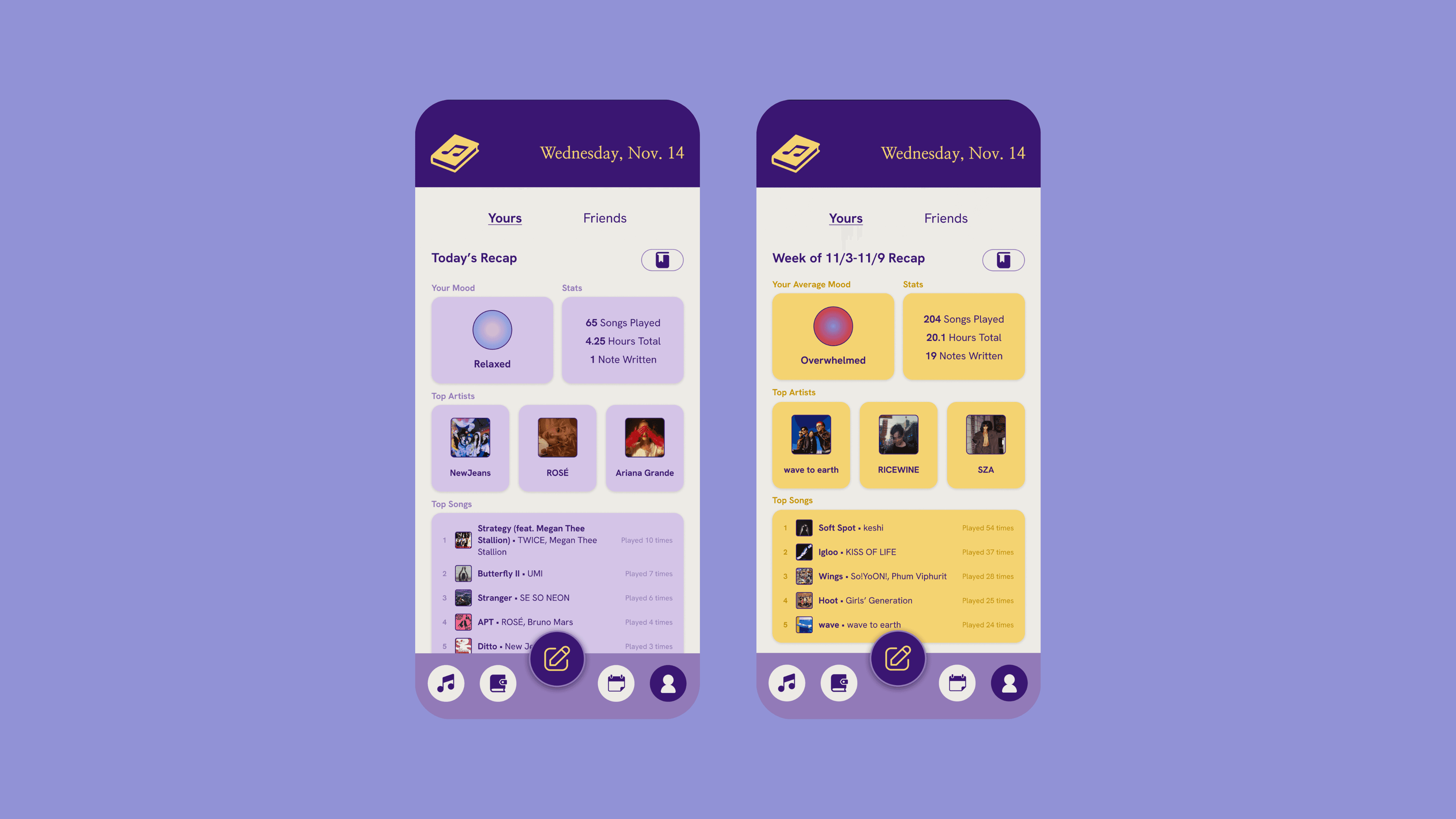
Periodic overviews of your emotions and music
The Dashboard includes daily and weekly recaps of your mood, music statistics, and the number of notes written.
MUSIC HISTORY
Explain your chosen (or shuffled) music
Want to briefly add the context for listening to a particular song? Write notes for any piece as the app syncs with your music listening app.
SOCIAL PREFERENCES
Share the vibe and connect
Recorded statistics and entries can be as personal or public as you want. Check in on your friends by toggling to the Friend View on the Dashboard or Music History tabs.
USER RESEARCH
Target interviewees
Based on these interests, I investigated whether others share similar experiences of music influencing their emotions and their opinions on sharing music socially. I also wanted to explore if journaling can be tied into this.
I interviewed 12 people who fall under the following categories through forms and interviews:
Research analysis
Interviewees shared similar experiences of curating music influenced by the particular vibes that it elicits or how they feel in a specific moment. Participants also revealed mixed feelings about publicizing music listening and journaling based on music.

"I have a few categories of playlists: ship-based, mood-based, or time-based."
"I have monthly playlists that are just new songs or songs I've already liked. Other playlists are just based on my mood and the theme/vibe of the playlist."
"It's fun to share my music history! I like seeing others so I figured they might like seeing mine as well."
"I feel like I'm being surveilled."
"I like to share with my friends and family because I like finding new songs within my own taste but also new genres."
PROBLEM
How might we use music listening history to identify patterns in emotions?
The insights that stood out to me the most revealed how people's emotions and experiences at a specific time can affect their listening history.
In reverse of this finding, the central question I hoped to tackle through the project is determining how music listening history can pinpoint mood patterns over time.
APPROACH
Wireframing and testing
Taking inspiration from other apps with similar features, such as Spotify, Instagram, BeReal, and AirBuds, I envisioned the app to be on mobile to prioritize the convenience of the music listening and journaling experience.


Initial feedback
Based on the wireframes and V1 screens, most of the preliminary feedback focused on sizing and unclear functionality of some features. Following these critiques, the second version incorporated changes to features and fleshed out functionality.
User testing
Three people were then interviewed to test the product with the following goals in mind. One tester had been in the preliminary research, while the other two had no prior knowledge of the app.
GOAL
Learn how users interpret the concept of dashboards/recaps and where they expect to find their own and friends’ summaries.
Primary feedback focused on ambiguous functions, confusing navigation, sizing issues, and features to incorporate or replace.
INSIGHTS
Constraints can be liberating
This project allowed me to hone my prototyping skills and consider which features to prioritize. It was easy to fall into the trap of endlessly adding new features, but the project's time constraints showed how quickly shipping a product in real life could look.
If I were to do things differently, here's what I would do: